
“Great question!
It almost sounds like you’re swearing doesn’t it?”
I always say that at the start of every initial session with a department within a company. Getting people on board with a thorough business analytics system is easier when you make it sound simple. Which it is really.
“What are the things, external and internal, that are stopping the business from growing in any environment? For instance, how did the 2020 pandemic affect everyone?”
The acronym VUCA was first coined by the U.S. Army War College in 1987.
It was created to describe the volatile, multi-lateral, and unpredictable world that emerged following the end of the Cold War. Suddenly, the geopolitical landscape lacked a single, predictable adversary, requiring military strategists to adapt to entirely new kinds of fluid environments.
Since 2001, it has been adapted by businesses realising that the corporate world was facing its own version of this turbulence—driven by rapid globalization and technological disruption. By the late 2000s, VUCA became a staple framework for executive leadership and strategic planning.
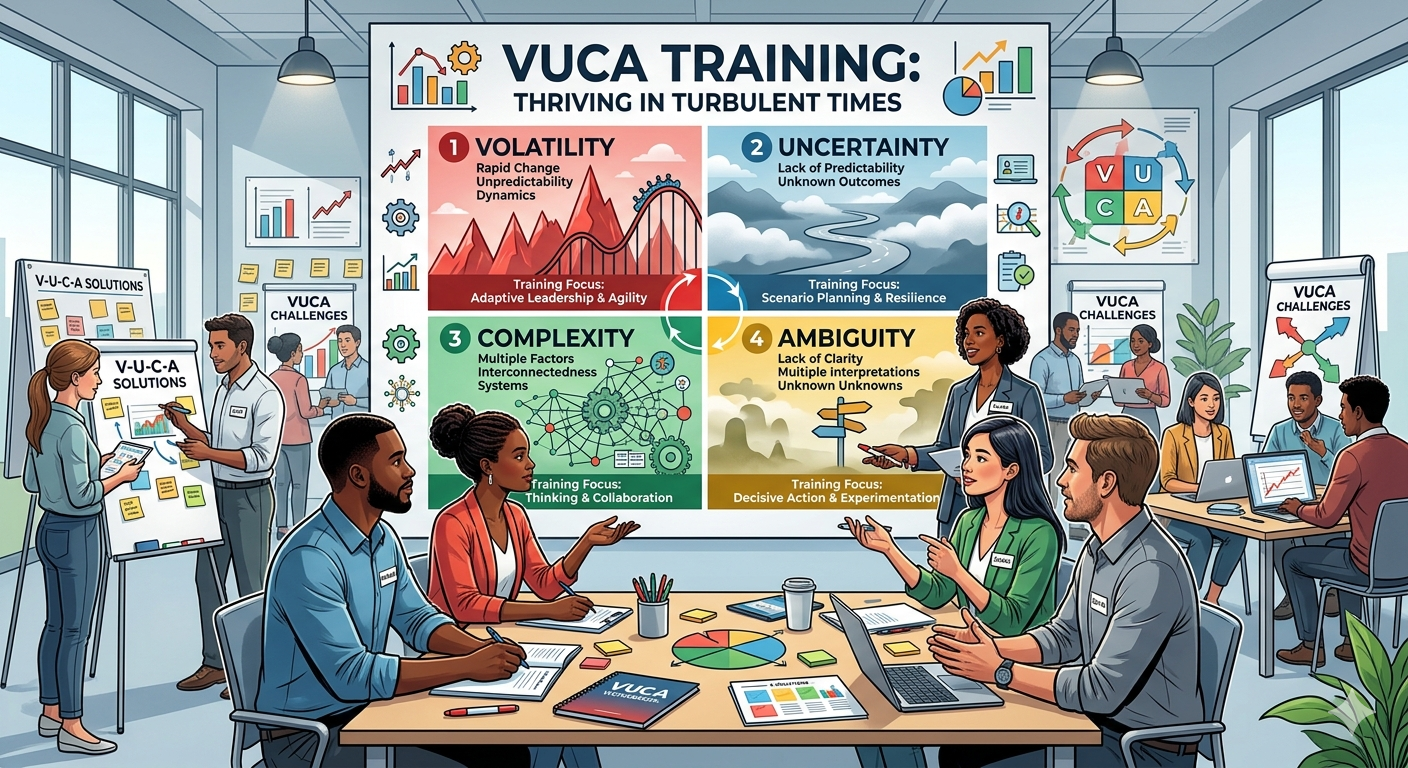
If you look at the image on this blog, you will see what elements are looked into during my VUCA sessions. The data I can extract from speaking to employees on the shop floor (so to speak) can reveal much more insight than KPI’s or other measurable data you might get from an audit.
In recent years, leadership experts have popularized VUCA Prime (Vision, Understanding, Clarity, Agility) as the direct strategy to flip the negative impacts of VUCA into a competitive advantage.
The VUCA leadership framework is the way forward. You can ensure your business is leading in a VUCA world skills future by embracing adaptive leadership strategies, creating decision making under uncertainty and managing complexity in business.
#VUCALeadership
#LeadershipDevelopment
#StrategicPlanning
#ChangeManagement
#AgileLeadership
#BusinessStrategy
#ResilientLeadership
#AdaptiveLeadership
#FutureOfWork


0 Comments